Showing posts with label How to make. Show all posts

Monday, June 11, 2012

Make Your Own Throw Blankets

throw blankets
Make Your Own Throw Blankets This Summer

Looking for a fun, easy craft to keep you occupied this summer? Try making your own throw blankets. Come wintertime, you’ll be happy to have extra throw blankets around the house. Likewise, these unique, handmade blankets make perfect gifts. Here are two ways you can make your own throw blanket this summer:

Fleece Tie Throw Blankets. For the novice crafter, fleece blankets are easy to make. Not only do they require no sewing skills, they’re relatively inexpensive to make. To begin, you will need to purchase a  1 ½ yard piece of polar fleece, ruler, and a rotary cutter. While a rotary cutter is ideal, a pair of sharp scissors will work just as well. When purchasing the fleece, ask the crafts associate to cut the material straight. Make sure to trim any uneven edges before beginning.  Next, you'll need to cut a 4-inch square out of each of the four corners of the fleece. The next step is to cut 4" x 1" wide fringe all the way around the blanket.
Once you've done that, you'll want to use a seam ripper to make tiny slits at the top of each piece of fringe. The final step is to feed the fringe pieces through the backside of the slit you cut and pull it through, creating a neat and secured fringed edge. If you are planning to give throw blankets as gifts, you may want to personalize them. To do so, take the finished blanket to a sports store or graphic design store that does embroidery. You can have the store embroider the recipient’s name or initials on the blanket.

Quilt. Unlike a fleece blanket, quilts require basic sewing skills and more time. If you are willing to invest the time and energy, however, quilting is a great way to reuse old fabric. In fact, quilts made up of old jerseys or t-shirts make wonderful keepsakes for your family. Once you've gathered up the fabric you're planning on using, you'll need to choose a pattern as well as backing and batting materials.
The batting, also known as the inner layer of the quilt, is what makes a quilt warm and soft. To purchase batting and backing, you'll need to go to a craft shop so a professional can assist you in selecting the right materials.
As far as patterns go, there are tons to choose from, and most are available for free online. Take care when choosing your quilt pattern, as the difficulty and time spent working on the quilt will depend on the pattern you choose. Once you have all of your fabric squares, lay them on the floor and piece the quilt together in diagonal rows. To secure the three layers before it comes time to sew, you'll want to pin them together. To do so, lie the backing material wrong side up on the ground and place the batting material on top.
Next, lay the quilt top onto the batting and smooth the layers, making sure that they all lay straight and flat. Starting at the center, pin the layers (quilt top, batting and backing) every 3 to 6 inches until the entire quilt has been pinned with safety pins. This will keep your quilt pieces together until you are ready for the final step - sewing it together.
Whether you make a fleece blanket or quilt, a handmade blanket is the perfect accessory to any room in your home.
Rebecca Travis is a 2nd grade teacher who loves reading and making crafts. She gets great craft ideas from Collections Etc.

Monday, December 12, 2011

How To Make an Exceptional Ring

 What You Need to Make an Exceptional Ring

Whether you want to wow the love of your life with a bespoke engagement ring, or set up your own jewellery making business, you are going to need the right tools for the job. But what are they, exactly? Here is a list of the equipment you will need to create such a spectacle, presented in order of what you'll need from start to finish.

Ring clamps


Credit: Mauro Cateb
Ring clamps can be made from a variety of materials ranging from plastic to wood and metal. They are used to hold rings while you work on them. Some clamps have one rounded end for working on eternity rings, and the other end is flat for working on cluster rings.

Pendant drill

Most jewellers would say this this tool is almost indispensable. This flexible cable drill consists of a motor unit, often suspended above the user, connected to a hand-piece by a flexible cable which transmits power down to the hand-piece. This allows the hand-piece to be small and light. Speed is often controlled using a foot pedal.

Grain tools

A grain tool is usually made from carbon steel. It looks like a long three-inch nail which has a concave hole in its point. It is mostly used for pushing claws over stones or rounding off grains which are raised by a half round scorper.

Grain tool holder

This is a small wooden handle with a screw chuck at one end for holding grain tools.

Needle files

credit: noriko.stardust
A needle file is a tool used to design or finish small pieces of material. This small tool has a series of teeth laid out on metal with a small handle, designed according to what kind of finish is required on an object. The file is used to smooth and shape metal, wood or glass and is often invaluable when creating intricate details onto an object. The friction created when the teeth of the needle file push against an object effectively shaves off pieces of the material until the effect that is required is produced.

Drills (assorted sizes)

These can be called burs (American) or fraizers (English). They are used for drilling out holes in metal and come in all shapes and sizes ranging from 0.5mm – 10mm. They are made of carbon steel and are used with the pendant drill.

Scorpers (many sizes and types)

The scorper is a tool, like a chisel, used by goldsmiths, silversmiths and jewellers for stone setting, carving shapes, cleaning castings and texturing surfaces as well as engraving.

Loupe

credit: Steven Brownlee
A loupe shows the jeweller or craftsman what the naked eye can’t: it magnifies an object, normally a diamond, ten times over. It is used to inspect the stone and is easy to use. A loupe normally has one or three lenses and allows the user to see the minute details of a stone. They can be mounted on stands or hand-held objects.

Pliers

Long nosed pliers are normally used by setters for straightening or moving claws.

Side cutters

These very sharp cutters are used for cutting down claws or wires.

Buff sticks

Buff sticks are used to polish jewellery, particularly in areas that are hard to polish by hand alone. They are usually flat and made from wood and felt or leather.

Setters buff sticks

These are made from a flat piece of wood about 12 inches long and are wrapped in sandpaper. They are used to take scratches out of the metal and come in different grades ranging from very course to very fine.

This guide was produced by Ingle & Rhode - London based jewellers of unique engagement rings, wedding rings and a variety of other bespoke jewellery designs.

Friday, July 30, 2010

Cheap wedding napkin rings

Making Wedding Napkin Rings image
How to Make Cheap Wedding Napkin Rings

Since I still have not gotten over the whole wedding theme, I've figured what would be a better way to conclude it than having a tutorial on how to make your very own wedding napkin rings

We will be using some very cheap and readily available materials and anyone can do as you wont be needing any special tools.
Making Wedding Napkin Rings image

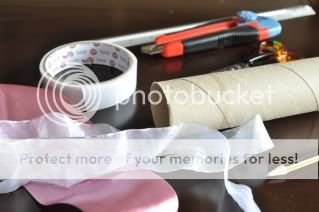
Things you will need:
- ruler
- scissors
- pencil for marking
- cutter
- double-sided tape
- wide satin ribbon
- pretty ribbons
- embellishment for decorations 
- cardboard tube (such as from kitchen towel)

Steps:
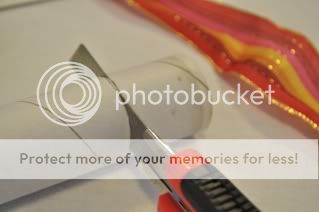
1.  Measure the cardboard tube using a ruler and mark it at several points using a pencil. 3-4cm is a good measurement for a napkin ring, but it is really up to your preference.
2. Use a  ruler to connect the points by drawing a straight line through them and slowly cut out the tube following the marked line with a sharp cutter knife.

Make your own wedding napkin rings imagebeading tutorial image
3. Cut the wide satin ribbon to a suitable length that will cover the whole of the cut-out tube. To make it easier, wrap the ribbon around the tube to measure. 
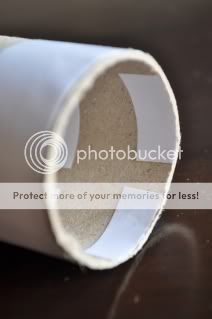
4. Line the outer tube with double-sided tape (do not peel off yet). Also line the inside of the tube but make sure to only put double-sided tape at the part where it will be covered by the ribbon. See pic.
*To make sure we have a nice and smooth napkin ring, make sure there are no trapped air bubble between the tape and the tube.

5. Place the ribbon on a flat surface. Peel off double-sided tape on the outer tube. Place tube on ribbon and gently roll it on the ribbon. 
*Satin ribbons are very delicate, to avoid it from being ruined,  never pull it sideways.
6. Peel off tape on the inside of the tube. Using your fingers, gently fold down the ribbons to the inside of the tube. 

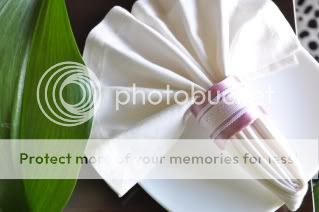
7. Your basic napkin ring is ready. Now it's time to decorate it! You can use any fancy ribbons or embellishment for this purpose.
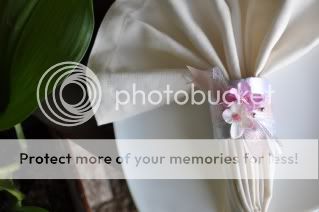
8. In this example, Ive combined two types of ribbons, by using a double sided tape, I taped them together and then onto the ring.

...and a simple yet elegant wedding napkin ring is created! 


Try it with various type of ribbons and designs, you can do all sorts of napkin rings for any occasion!

Thursday, June 24, 2010

How to make beaded napkin rings


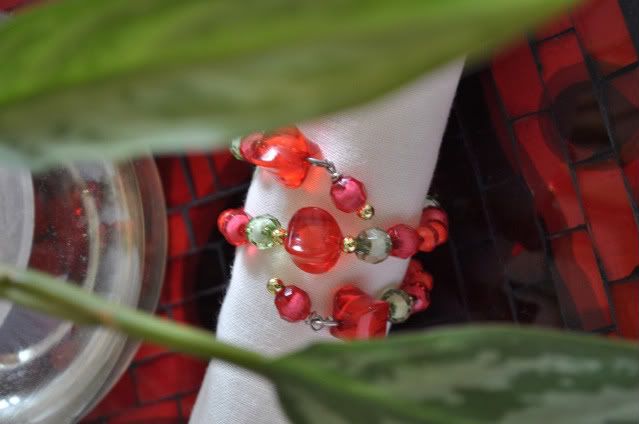
Tutorial: How to make spiral beaded napkin rings - Beading for beginners

- I've been getting requests on how to make these napkin rings. So I've decided to start with probably the simplest design - the spiral napkin ring. These are fun to make since we'll be using a lot of beads. And it is up to your own imagination and creativity in deciding which type, and sizes of beads, and color or combination of colors to be used. I am using plastic beads this time to show how even the least expensive of beads can be made into a pretty stunning napkin ring.


Materials you will need:
Beads, Thick Wire (about 1.2mm gauge), Headpins (x2)

Tools:
Round-nose pliers, Flat-nose pliers, Tube shaped object


Step 1:
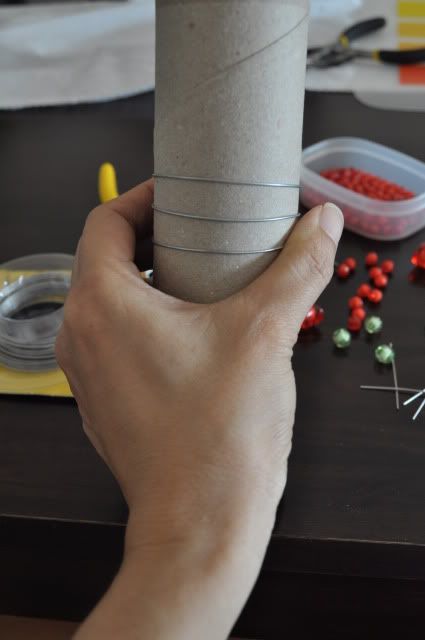
Wrap the thick wire around the tube several times to create a spiral. Remove the wire carefully without pulling it out of shape. 

Step 2: 
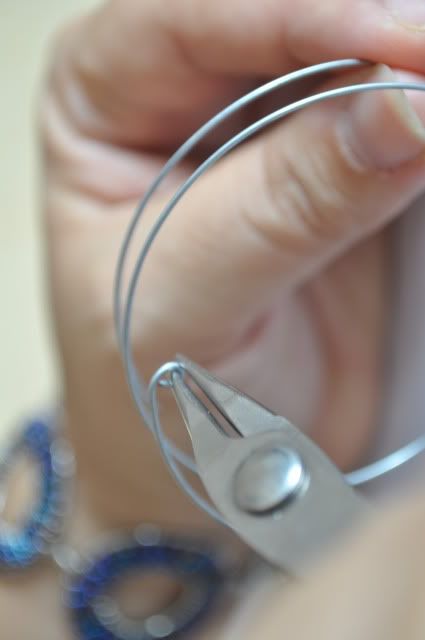
By using the round-nose pliers, bend one end of the wire into a small loop.

Step 3:
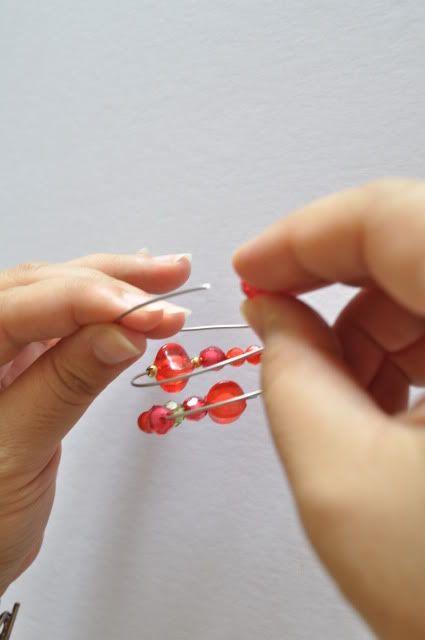
Insert or thread the beads on to the spiral wire. 

Step 4: 
Once all beads are threaded, make a similar loop at the end of the wire. 


 Step 5:  
(This is a tricky step and can be skipped. If this step is skipped, then just use the flat nose pliers to pinch the end loops down so they stay somewhat hidden from view.)
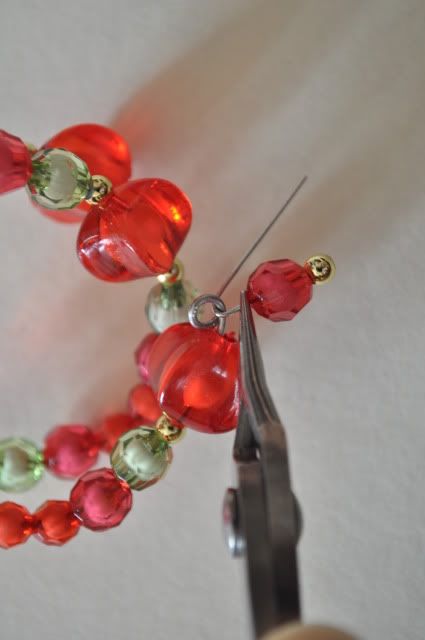
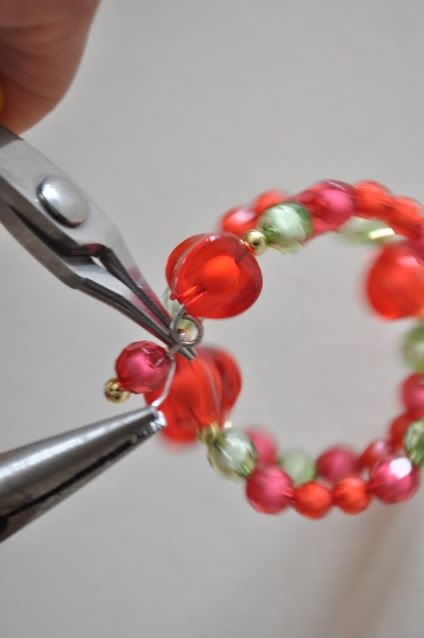
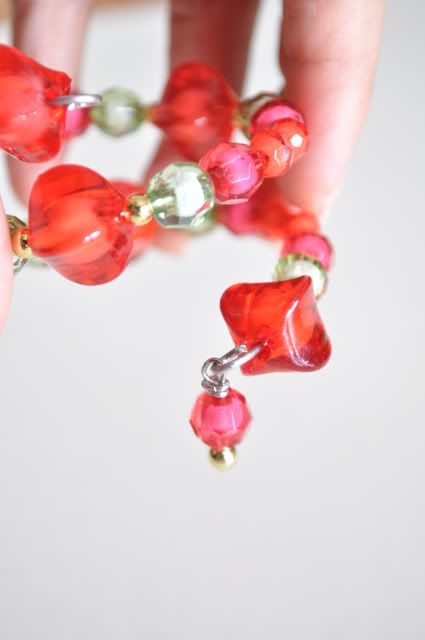
Time to dangle some beads on the end loops. To do this:
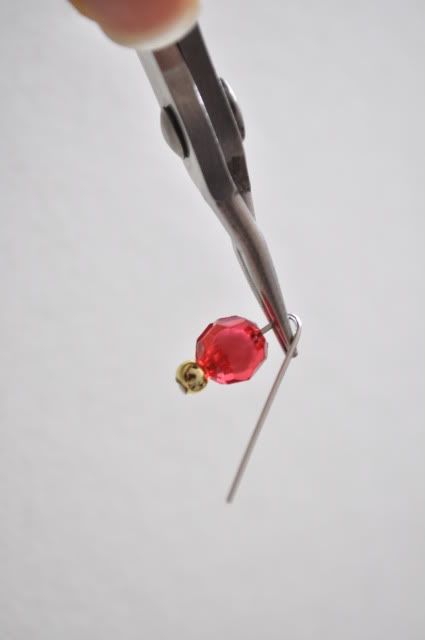
a) Slide a bead onto a headpin and with a round-nose pliers firmly grasping the wire just above the bead (this is called the neck), bend the wire down to a sharp angle 
b) Slide the headpin through one of the loops of the napkin ring
c) Use the round-nose pliers to grasp firmly at wire just above the bead and hold the tail wire with a flat-nose pliers and create create a loop by wrapping it around tip of the round-nose pliers then slowly wrap the wire around the neck of the headpin several times
d) Cut the rest of the tail wire

And voila! Your very own simple but yet elegant little napkin ring. I hope this tutorial has been useful to you. Please drop your comments, I would love to hear from you :)


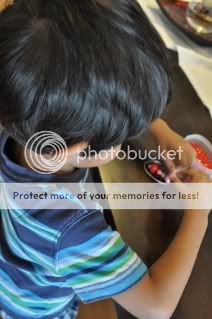
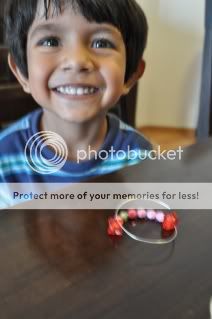
Here's some pictures of my 3.5yo son making his napkin rings while I was preparing this tutorial. Yup, it's that easy to make :)


Tuesday, May 4, 2010

Beaded Napkin Rings In The Making

Charming Beadz @ Work

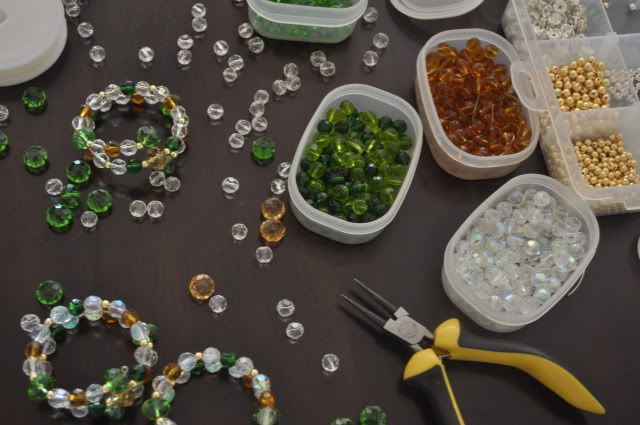
I've chosen design #1 for the order. 16 pieces.. will take a few hours to complete it. The good thing about this spiral design is they are easy to make. Here's how my table looks like when I'm at work.. 


And the finish products..


About me

Total Pageviews

Followers

Copyright © 2009-2011 Community is Designed by Bie Converted To Community Galleria by Cool Tricks N Tips

Privacy Policy|Napkin Rings